KNEE CONDITIONS & TREATMENTS > PATELLA DISLOCATIONS
LEARN ABOUT YOUR KNEE
Patellofemoral instability
Learn about patellar instability, dislocations and treatment options.
Book a consultation with Dr Jon Liew to talk about your knee.
GENERAL INFORMATION
What is patellofemoral instability?
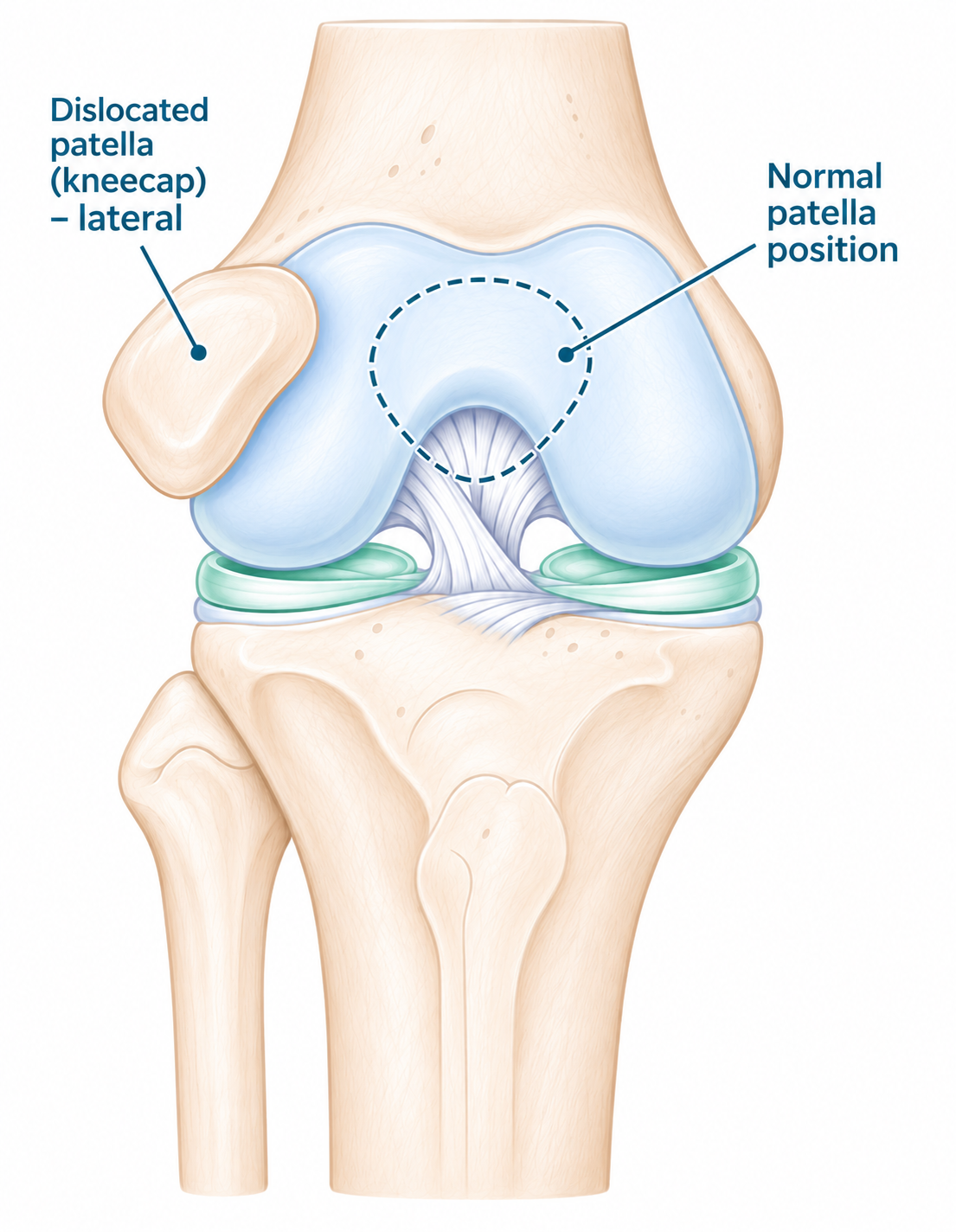
The patella (kneecap) normally glides within a groove called the trochlea at the end of the femur (thighbone) as the knee bends and straightens. Patellofemoral instability occurs when the kneecap slips partially out of this groove (subluxation) or completely out of position (dislocation).
Patellar dislocations usually occur towards the outside of the knee and are most common in younger, active people. They can occur during sudden changes in direction, twisting movements or awkward landings.
A dislocation can damage the medial patellofemoral ligament (MPFL), which helps stabilise the kneecap towards the inside of the knee, and may also cause injury to the joint cartilage.
SUPPORT GUIDE
I dislocated my kneecap!
A patella dislocation is often associated with a sudden sensation that the kneecap has “popped out” or shifted. You may have been in significant pain with difficultly putting weight through the leg, along with swelling and pain limiting movement.
In many cases, the kneecap moves back into position spontaneously but sometimes needs to be relocated in the emergency department. Even after it has returned to its normal position, your knee may remain swollen, painful and feel unstable. Some people describe a feeling that the kneecap is going to “slip out” again, particularly when turning, squatting or going downstairs.
A patella dislocation can also damage the cartilage on the back of the kneecap or the surface of the thighbone. The medial patellofemoral ligament (MPFL), an important stabilising ligament, is usually injured during a dislocation.
An assessment includes a thorough history and gentle examination of the knee, looking for risk factors of another dislocation. Imaging is particularly important after a first-time dislocation to assess for cartilage or ligament injuries and to identify factors that may increase the risk of further instability.
Why does it happen?
A twisting movement, awkward landing or direct impact may cause a dislocation. Some people are more susceptible because of a shallow groove, a high-riding kneecap, loose ligaments or differences in leg alignment.
PATELLAR INSTABILITY
Symptoms & Assessment
Symptoms may include:
A sudden painful shift of the kneecap
Swelling after a dislocation
A feeling that the kneecap may slip out
Apprehension with turning, running or changing direction
An assessment involves examining kneecap movement, ligament stability and leg alignment. X-rays and MRI help identify cartilage injuries and anatomical risk factors. Additional imaging is sometimes required as well.
PATELLAR INSTABILITY
Treatment options
Treatment depends on whether this is a first-time dislocation or a recurrent problem, the presence of associated injuries and any underlying anatomical factors that increase the risk of instability.
A first-time patellar dislocation does not automatically require surgery, and most patients recover well with appropriate rehabilitation.
The decision to recommend surgery depends on several factors, including the number of previous dislocations, the presence of cartilage or bone injuries, your individual knee anatomy and your sporting or activity goals.
Surgery may be recommended for recurrent dislocations, persistent instability or significant associated injuries. In selected patients with a high risk of recurrence, surgery may also be considered after a first-time dislocation.
Ultimately, treatment is individualised, with the aim of restoring knee stability, preventing further injuries and helping you return to your usual activities.
PATELLAR INSTABILITY
Non-surgical Treatment
Non-surgical treatment is usually recommended following a first-time patellar dislocation, provided there is no significant associated cartilage or bone injury.
The knee is often swollen and painful initially, so a short period of immobilisation in a brace (usually 1–2 weeks) may be recommended. Crutches may also be required during this time. Gentle knee movement is then encouraged as pain and swelling improve.
Once the knee has settled, physiotherapy becomes an essential part of recovery, helping to restore normal function and reduce the risk of future dislocations. Rehabilitation focuses on restoring knee movement, strengthening the quadriceps and hip muscles, and improving balance and control during everyday and sporting activities.
PATELLAR INSTABILITY
PATELLAR INSTABILITY
Surgical treatment
Surgery aims to restore kneecap stability and reduce the risk of further dislocations. The choice of procedure is individualised, based on the underlying cause of instability, and sometimes a combination of procedures is required to achieve the best outcome.
MPFL reconstruction
An MPFL reconstruction restores the function of the damaged ligament, helping to restrain the kneecap and guide it into the trochlea (the groove at the end of the femur), where it normally articulates. A tendon graft is used to reconstruct the ligament, typically secured to the patella and femur using small anchors or other fixation devices.
Osteotomy and realignment
A tibial tubercle osteotomy may be required to reposition the attachment of the patellar tendon, improving kneecap alignment and tracking. In some patients, additional procedures to correct the alignment or rotation of the leg (femoral or tibial osteotomies) may also be necessary.
Rarer procedures, such as a trochleoplasty, which involves reshaping an abnormally shallow trochlear groove, are reserved for carefully selected patients.
Cartilage and bone procedures
If a dislocation causes a significant cartilage or bone fragment to break away, surgery may also be required to repair or remove the fragment.
The choice of procedure is individualised, with the aim of addressing the underlying cause of instability rather than performing the same operation for every patient.
Risks of surgery
As with any operation, there are risks, including infection, blood clots, stiffness, persistent pain and recurrent instability. Procedures involving bone realignment also carry risks of delayed bone healing and irritation from implants.
Although surgery is generally effective at improving stability, no procedure can completely eliminate the risk of further dislocations.
PATELLAR INSTABILITY
-
Not necessarily.
Most people who dislocate their patella do not have any further dislocations. However, the more dislocations you have, the higher the chance it will continue to dislocate.
Some people are more likely to experience further dislocations, particularly younger patients and those with certain anatomical features, such as a shallow trochlear groove or a high-riding kneecap. I assess for these risk factors during a consultation. -
It is a type of dislocation around the knee, but not a ‘knee dislocation’. A kneecap dislocation involves the patella leaving its groove. A dislocation between the thighbone and shinbone is a different, potentially limb-threatening injury.
-
I generally recommend an MRI following a first-time patella dislocation. It helps identify injuries to the MPFL, cartilage or underlying bone that may not be visible on an X-ray. It can also identify some of the anatomical factors that increase the risk of future dislocations.
-
Yes, when appropriate. Surgery must account for remaining growth, and techniques may be adapted to protect the growth plates.
-
Not always, but recurrent dislocations are a common reason to consider surgery.
Each dislocation can potentially cause further cartilage damage, and ongoing instability may affect your confidence and ability to participate in activities.
The decision depends on your symptoms, anatomy, activity goals and the risk of further injury. -
Recurrent dislocations can increase the risk of developing arthritis, as each episode can cause further damage to the cartilage on the underside of the kneecap or within the trochlear groove. However, not everyone with patellofemoral instability will develop arthritis.
As it is difficult to predict who will develop arthritis in the future, preventing further dislocations may help protect the long-term health of your knee.
Frequently Asked Questions (FAQ)
HOW I CAN HELP
Surgical procedures I offer for patellofemoral instability, when clinically appropriate:
MPFL Reconstruction
Tibial tuberosity transfer (osteotomy)
Realignment procedure (osteotomy)
Trochleoplasty (although this is a rarely performed operation)

CONTACT US
Make some time for you and your knee
Dr Jon Liew consults at the San Clinic (Wahroonga) on Sydney’s Upper North Shore.