KNEE CONDITIONS & TREATMENTS > MENISCAL INJURIES
LEARN ABOUT YOUR KNEE
Meniscal Injuries
Learn about meniscal tears, treatment options and recovery.
Book a consultation with Dr Jon Liew to talk about your knee.
Meniscal Injuries
ON THIS PAGE
> Repair vs Removal
> Recovery & Risks
GENERAL INFORMATION
What is the meniscus?
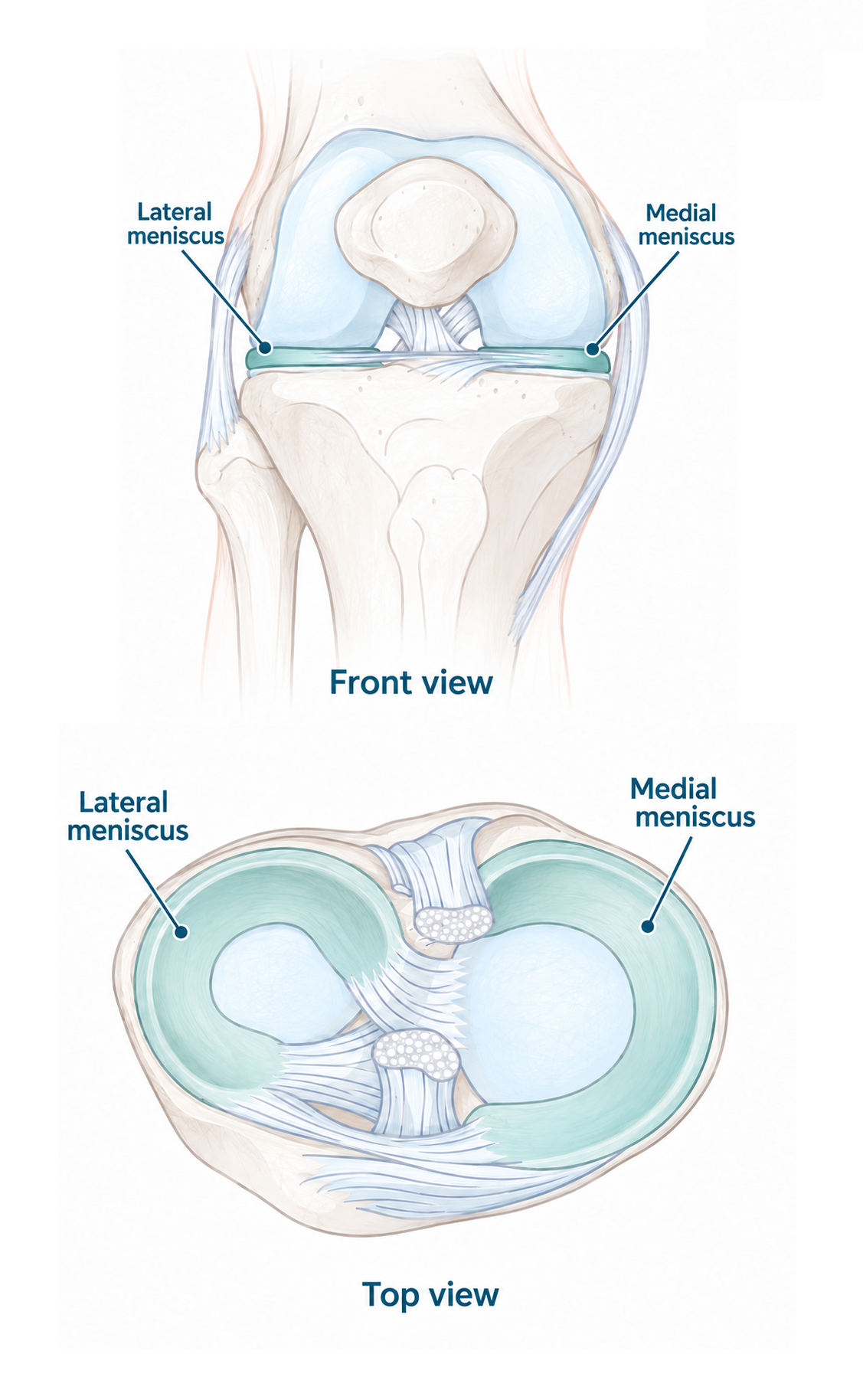
There are two types of cartilage in the knee. The first is articular cartilage, which covers the ends of the femur (thighbone) and tibia (shinbone), allowing the knee joint to move smoothly. The second type is the menisci (singular: meniscus), which are two crescent-shaped structures that sit between the femur and tibia. They act as shock absorbers, help distribute load across the knee and contribute to joint stability. Together, these functions help protect the articular cartilage and reduce the risk of developing arthritis.
Meniscal tears are common and can occur due to trauma (acute), degeneration (chronic) or a combination of both (acute-on-chronic). Tears can vary considerably in size, shape and configuration.
SUPPORT GUIDE
I’ve torn my meniscus!
Symptoms of a meniscal tear can vary widely. Some people have no symptoms at all, with the tear discovered incidentally on a scan. Others may experience pain along the inside or outside of the knee, particularly with twisting, squatting or kneeling. Some people develop ‘mechanical symptoms’ such as clicking, catching or locking, while others simply feel that their knee is not moving normally.
Your assessment involves understanding how the injury occurred, where the pain is located and whether any mechanical symptoms are present. A clinical examination, often combined with an MRI scan, can help assess the tear and the overall condition of your knee, and determine whether the meniscal tear is responsible for your symptoms.
Not all meniscal tears require surgery, and these findings help guide the most appropriate treatment for your individual circumstances. Find out more information below ↓
MENISCAL SURGERY AT A GLANCE
Operation
Arthroscopic (keyhole) meniscal repair or partial meniscectomy
Anaesthetic
Usually general anaesthetic, often with additional regional anaesthesia
Hospital stay
Usually same day or one night
Weight bearing
Repair: Non-weightbearing 6 weeks, Meniscectomy: immediately
Knee brace
Repair: 6 weeks, Meniscectomy: no brace required
Return to work
Desk work often 2 weeks; physical work usually earliest is 6-8 weeks if repaired
Return to running
Repair: 3-6 months, Meniscectomy: 1-2 months
Return to sport
Repair: 6-9 months, Meniscectomy: 2-3 months (depending on several factors)
MENISCUS
Types of meniscal tears
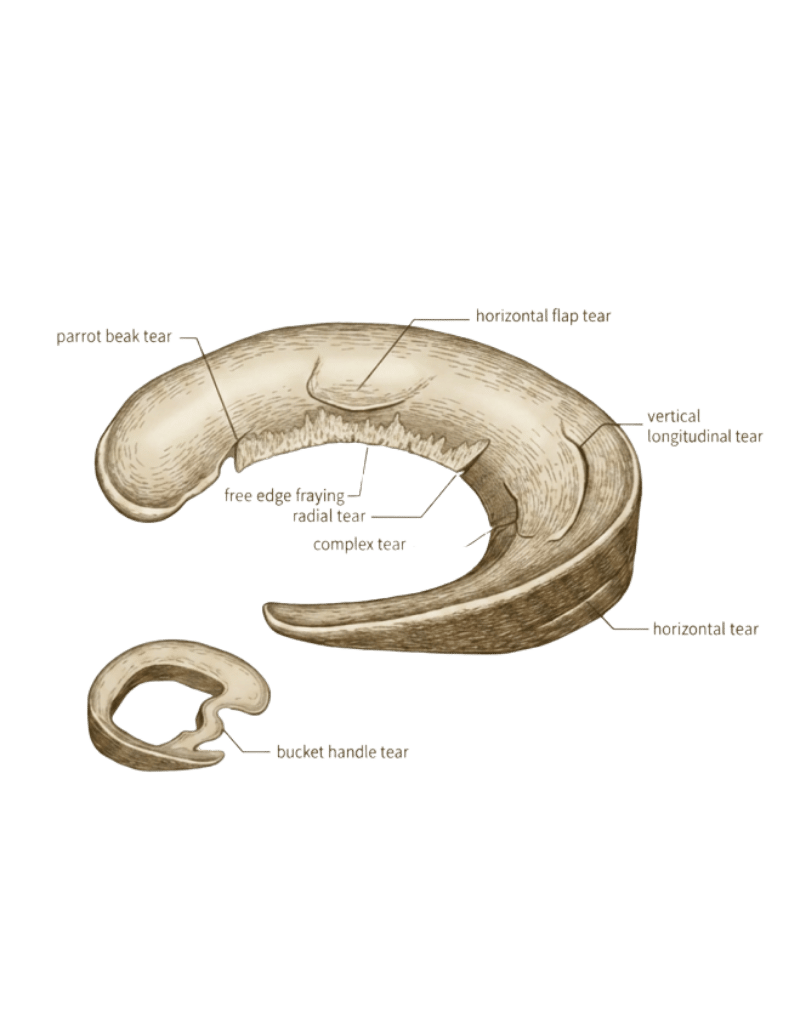
Meniscal tears can vary in their location, size, shape and severity. Common patterns include vertical (longitudinal), horizontal, radial, flap and complex tears. Some larger tears can become displaced, such as a bucket-handle tear, which may cause the knee to catch or lock. Tears can also occur near the attachment of the meniscus to the bone, known as meniscal root tears.
The type and location of a tear are important, as they influence whether the meniscus is likely to heal, whether it can be repaired and which treatment options are most appropriate.
MENISCUS
Symptoms & Assessment
Symptoms may include:
Pain along the inner or outer joint line
Swelling, particularly after activity
Pain with squatting or twisting
Catching or difficulty fully straightening the knee
An assessment involves examining your knee and reviewing your symptoms.
An MRI helps to confirm the diagnosis, assess the type of tear and any associated cartilage changes. However, not every tear seen on MRI causes symptoms.
MENISCUS
Treatment options
Treatment depends on several factors, including the type and location of the tear, your age, activity level, symptoms and the overall condition of your knee.
An MRI showing a meniscal tear does not necessarily mean that surgery is required. The key considerations are whether the tear is responsible for your symptoms, whether it is likely to heal and whether your symptoms are likely to improve with non-operative treatment.
Treatment is therefore highly individualised. In younger patients, particularly those with acute injuries, surgery may be recommended to repair and preserve the meniscus, potentially reducing the risk of future arthritis. In older patients, particularly those with degenerative tears, non-operative treatment is often preferred initially.
Ultimately, the decision is based on your individual circumstances, with the aim of relieving symptoms, preserving knee function and protecting the long-term health of your knee.
MENISCUS
Non-surgical treatment
Many meniscal tears can be managed successfully without surgery, particularly degenerative tears, those that are not causing significant symptoms, and those whose symptoms are improving.
Treatment usually involves a combination of activity modification, physiotherapy and appropriate pain relief. Rehabilitation focuses on restoring knee movement, strengthening the surrounding muscles and gradually returning to normal activities. Activity modification (avoiding activities that aggravate symptoms, such as deep squatting or twisting) also helps.
Degenerative meniscal tears are usually treated without surgery initially, particularly when there is associated arthritis. Although the tear itself may not necessarily heal, symptoms can gradually improve over several weeks to months, even if the tear remains visible on an MRI scan.
The aim is to improve your symptoms and restore function, rather than simply treating what is seen on a scan. Many patients can return to their usual activities without requiring surgery.
MENISCUS
Surgical treatment
Surgery may be recommended for certain types of meniscal tears, particularly those that are displaced, cause locking of the knee or have a good chance of healing following repair. Bucket-handle tears are one example that may require more urgent surgical treatment. Surgery may also be considered when symptoms persist despite appropriate non-operative treatment.
Most meniscal procedures are performed arthroscopically (keyhole surgery) through small incisions. The aim is to relieve symptoms while preserving as much of the healthy meniscus as possible.
There are two main surgical options: meniscal repair and partial meniscectomy. The choice depends on the characteristics of the tear and whether the damaged tissue is likely to heal following repair.
MENISCUS
Meniscal repair or removal (meniscectomy)?
Where possible, meniscal repair is preferred because preserving the meniscus helps maintain its important role in distributing load and protecting the joint, potentially reducing the risk of arthritis over time. Whether a tear can be repaired depends on its location, pattern, tissue quality, blood supply and the overall condition of the knee.
However, repair is not always possible or appropriate. Some tears are too small, involve poor-quality tissue or occur in areas with limited healing potential. Occasionally, attempting a repair may cause more damage than benefit.
In these situations, a partial meniscectomy may be performed, where only the damaged or unstable portion of the meniscus is removed, preserving as much healthy tissue as possible.
In some circumstances, patients may prefer a partial meniscectomy because recovery is generally quicker, whereas meniscal repair requires a longer period of rehabilitation and activity restrictions. The decision is individualised, balancing the benefits of meniscal preservation against the likelihood of successful healing, expected recovery and your personal goals.
Certain tears, such as meniscal root tears, may require specialised repair techniques. In rare circumstances where most or all of the meniscus has previously been removed, meniscal transplantation may be considered in carefully selected patients.
MENISCUS
Recovery and Risks
Recovery depends on the procedure performed, with meniscal repair generally requiring a longer rehabilitation period than partial meniscectomy.
Those that have a partial meniscectomy will be able to weightbear immediately, although they may require crutches for support for 1-2 weeks. Pain and swelling gradually improves over the following weeks, and return to all usual activities is usually within a 4-8 weeks.
After a meniscal repair, recovery is much slower in order to protect the repair and allow the meniscus time to heal. Patients are usually placed into a hinged knee brace to control movement, and kept non-weightbearing (not putting weight through the leg, using crutches) for a period of 6 weeks. Return to sports can be up to 6-9 months depending on their progress.
Physiotherapy is important for recovery to assist the joint to return to optimal movement, strength and muscle control.
Risks of surgery
As with any operation, there are risks, including infection, blood clots, stiffness, persistent pain and further meniscal tearing. A repaired meniscus may not heal successfully and occasionally requires further surgery.
Removing meniscal tissue can increase stress on the remaining joint surfaces and the risk of developing arthritis over time. This is why preserving as much healthy meniscus as possible is an important priority when considering surgical treatment.
MENISCUS
-
Yes, some meniscal tears can heal naturally. Smaller tears near the outer edge of the meniscus have a better blood supply and are more likely to heal. However, even if a tear does not heal completely, symptoms can improve significantly without surgery.
-
No. Only certain tears require immediate surgery. The majority can be treated without surgery, and improve with rehabilitation. Treatment depends on your symptoms and the type of tear, rather than the MRI alone.
-
Not necessarily. Many meniscal tears remain stable and symptoms may improve with time and rehabilitation. However, certain tears require surgery - particularly displaced or unstable tears - as they can become larger, cause ongoing symptoms or lead to further damage if not treated. The risk depends on the type of tear and your activity level.
-
If your knee becomes stuck and cannot fully straighten, seek prompt assessment. A displaced meniscal tear may be blocking movement.
-
Whilst that is one of the goals, no operation guarantees prevention. Preserving functioning meniscal tissue theoretically helps protect the knee, but any cartilage damage already present and other joint changes still influence the development of arthritis.
Frequently Asked Questions (FAQ)
HOW I CAN HELP
Surgical procedures I offer for meniscal injuries, when clinically appropriate:
Knee Arthroscopy
Meniscal Repair
Partial meniscectomy
Meniscal root repairs ± centralisation
Meniscal Transplant (although this is a rarely performed operation)

CONTACT US
Make some time for you and your knee
Dr Jon Liew consults at the San Clinic (Wahroonga) on Sydney’s Upper North Shore.