KNEE CONDITIONS & TREATMENTS > OTHER LIGAMENT INJURIES
LEARN ABOUT YOUR KNEE
PCL, MCL & LCL Injuries
Learn about the other major ligaments in the knee
Book a consultation with Dr Jon Liew to talk about your knee.
GENERAL INFORMATION
What are ligaments?
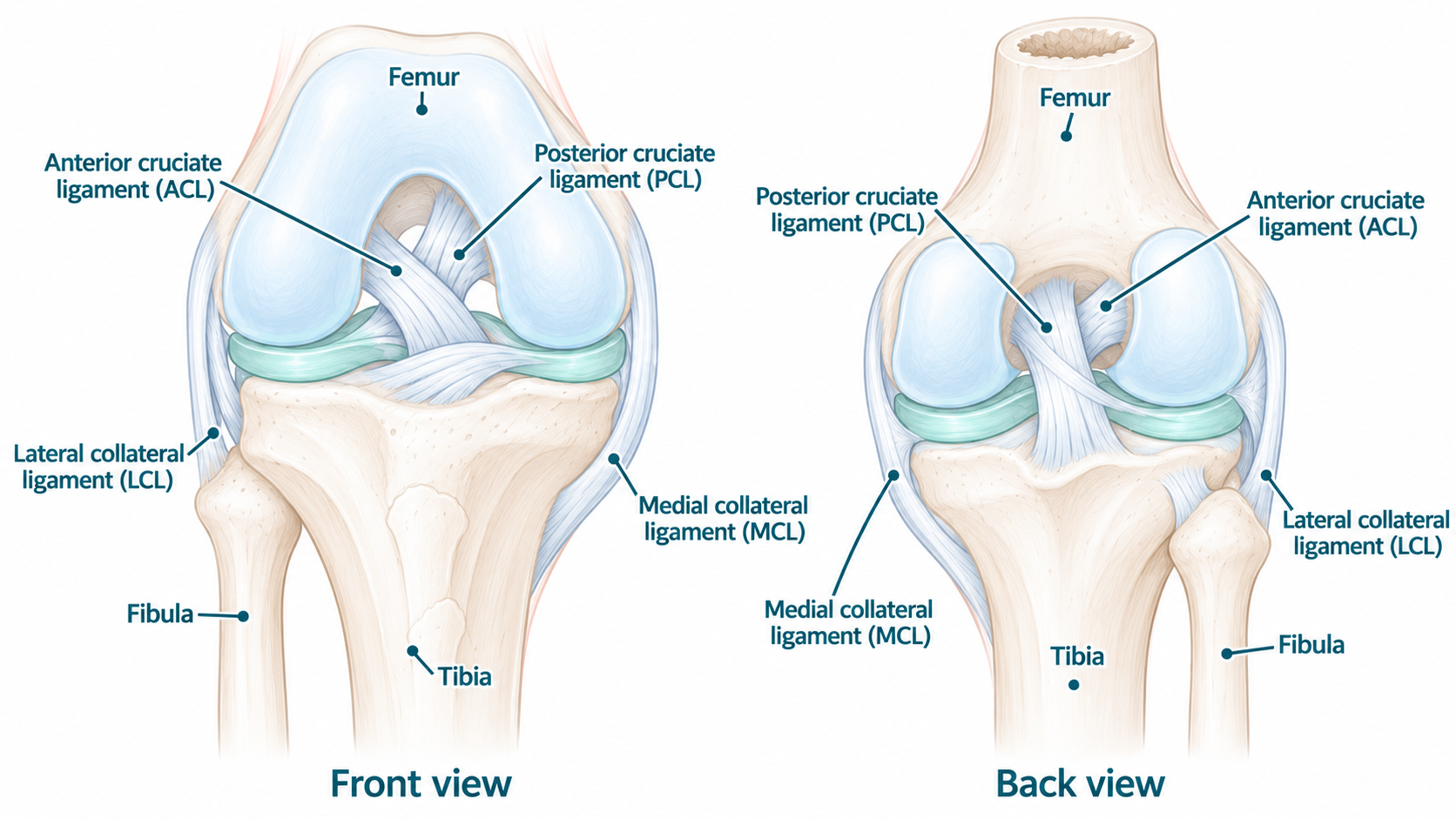
Ligaments connect bone to bone and help control knee movement. Alongside the anterior cruciate ligament (ACL), the posterior cruciate ligament (PCL), medial collateral ligament (MCL) and posterolateral corner (PLC) are other major ligaments which provide stability during everyday activities and sport.
These structures may be injured individually or together. Some injuries heal well with bracing and rehabilitation, while others require surgery to restore stability.
LIGAMENTS
Posterior Cruciate Ligament (PCL) Injuries
What is the PCL?
The PCL is a strong ligament inside the knee, towards the back of the joint. It connects the femur to the tibia and its main role it is to prevent the tibia from moving too far backwards.
PCL injuries commonly occur when a force pushes the shin backwards while the knee is bent, such as when falling onto a bent knee during sport or the front of the knee striking the dashboard in a car accident.
Symptoms and assessment
Symptoms may include:
Pain, swelling and stiffness after the initial injury
Discomfort at the back of the knee
Difficulty with stairs, slopes or slowing down
A feeling that the knee is unreliable or giving way
PCL injuries can be less obvious than other ligament injuries. Some people can still walk reasonably well but notice that their knee does not feel quite right.
A clinical assessment involves checking the resting position of the tibia and amount of backward movement of the tibia (posterior drawer test). An MRI is usually required to formally confirm a PCL rupture and assess for other injuries to the knee.
Non-surgical treatment
Most isolated PCL injuries can be managed successfully without surgery. Unlike some other knee ligaments, the PCL has a relatively good capacity to heal. This can be optimised through the use of a specialised PCL brace, which gently pushes the tibia (shinbone) forwards, also helping the ligament heal in the correct position.
The brace usually needs to be worn almost continuously for several months, and crutches are often required during the first few weeks.
Physiotherapy is an important part of recovery, both during and after bracing. Rehabilitation focuses on restoring knee movement and strengthening the quadriceps muscles at the front of the thigh, which help stabilise the knee and support the function of the PCL.
Surgical treatment
Surgery may be considered for:
Persistent instability or pain despite rehabilitation
Significant instability affecting work or sport
Combined injuries involving other knee ligaments
A displaced bone fragment pulled away by the PCL
A torn PCL is usually reconstructed using a tendon graft. If the ligament has pulled off a piece of bone, fixing the fragment back into position may be appropriate instead. The operation is tailored to the injury pattern.
LIGAMENTS
Medial Collateral Ligament (MCL) Injuries
What is the MCL?
The MCL runs along the inner side of your knee. It helps stop the knee from buckling inwards and contributes to stability when you turn or change direction.
The MCL can be injured when a direct force is applied to the outside of the knee, or through a twisting movement. It can be injured in isolation or combined with another ligament injury, most commonly the ACL.
Symptoms
Common symptoms include:
Pain and tenderness along the inner side of your knee
Swelling or bruising
Discomfort when twisting or moving sideways
A feeling that your knee might give way
The amount of pain does not always tell us how badly the ligament is injured, so checking the stability of your knee is important.
Clinical Assessment
I will examine the tender area and gently check how much the inner side of your knee opens under pressure. X-rays or an MRI may help clarify the injury and check for other damage.
MCL injuries (like other ligament injuries) are often classified by grade:
Grade 1: A mild sprain, with the knee remaining stable
Grade 2: A partial tear, with some increased looseness
Grade 3: A complete tear, with more significant instability
Non-surgical treatment
Most MCL injuries, including many complete tears, can heal successfully without surgery.
For anything other than minor injuries, a hinged knee brace is usually recommended to protect the ligament while it heals, whilst still allowing controlled movement. Crutches are often required initially, particularly if weight bearing is painful or restricted in the brace.
I will review your progress throughout recovery to ensure the ligament is healing appropriately and your knee is becoming more stable.
Surgical treatment
Surgery is less commonly required for isolated MCL injuries, as most can heal successfully without an operation. However, surgery may be recommended in certain situations, including:
The torn ligament has moved out of position or become trapped, making natural healing less likely.
The knee remains unstable despite appropriate bracing and rehabilitation.
There are associated ligament injuries that require surgical treatment.
MCL repair may be possible following a recent injury, where the torn ligament is reattached to its original position. For older injuries or tears that are unlikely to heal successfully, MCL reconstruction using a tendon graft may be required.
Having an ACL tear at the same time does not automatically mean the MCL requires surgery. In combined ACL and MCL injuries, my preference is usually to allow the MCL time to heal with bracing and rehabilitation before reassessing knee stability and discussing the need for ACL reconstruction.
This staged approach allows the MCL an opportunity to heal naturally, potentially avoiding the need for surgery on both ligaments.
LIGAMENTS
Posterolateral corner (PLC) Injuries
What is the posterolateral corner?
The posterolateral corner (PLC) is a group of ligaments and supporting structures located along the outer and back part of the knee. The main structures in this group are the lateral collateral ligament (LCL), popliteus tendon and biceps femoris tendon. Other structures included in this group are the popliteofibular ligament, joint capsule, arcuate ligament and lateral gastrocnemius muscle.
Together, they help control sideways movement, rotation and hyperextension of the knee.
PLC injuries are less common than ACL or MCL injuries but are more likely to cause significant instability.
Symptoms and assessment
Pain and swelling along the outer or back part of the knee
Instability when walking, turning or changing direction
A sensation of the knee giving way or overstraightening
Occasionally, numbness or weakness in the foot due to associated peroneal nerve injury
A clinical assessment involves a detailed clinical examination assessing the knee, as well as rotational and sideways stability. An MRI is usually required to assess the ligaments.
Non-surgical treatment
Mild, isolated PLC injuries with a normal clinical examination may be managed without surgery. Sometimes a hinged knee brace may be required for several weeks, along with crutches and activity modification.
Surgical treatment
More severe PLC injuries, such as complete tears, usually surgery to restore stability. Depending on the injury, this may involve repair or reconstruction of the damaged structures, sometimes alongside reconstruction of other injured ligaments.
LIGAMENTS
Multiligamentous Injuries
Some knee injuries involve damage to more than one ligament. These are known as multiligament knee injuries and can occur following significant sporting injuries, falls or motor vehicle accidents.
These injuries can cause substantial knee instability and may sometimes involve damage to the nerves or blood vessels around the knee.
Treatment requires careful assessment of all injured structures and may involve bracing, rehabilitation, surgery or a combination of approaches, depending on the severity and pattern of injury.
Unfortunately, multiligament injuries are often more complex to treat and generally have less predictable outcomes than isolated ligament injuries. Recovery can be prolonged, and some patients may experience ongoing stiffness or instability despite appropriate treatment.
LIGAMENTS
-
A brace helps protect the injured ligament while it heals and prevents movements that may stretch it in the wrong direction.
Different ligaments require different types of braces. For example, a specialised PCL brace helps hold the shinbone forwards to encourage healing in the correct position. Depending on the injury, bracing may be required for several weeks to many months. -
Recovery depends on the severity of the injury.
Many MCL injuries heal over approximately 6–12 weeks, although more severe tears may take longer.
PCL injuries often require several months of bracing and rehabilitation. Returning to sport may take considerably longer, depending on strength, stability and the demands of your sport. -
The quadriceps muscles at the front of your thigh help pull the shinbone forwards, supporting the function of the PCL. Strengthening these muscles can improve knee stability and function while the ligament heals.
-
Potentially. Significant ligament injuries can alter how forces are distributed through the knee, particularly if ongoing instability develops. Associated cartilage or meniscal injuries may also increase the risk of arthritis over time. However, not everyone with a ligament injury develops arthritis. Restoring stability and protecting the joint are important goals of treatment.
Frequently Asked Questions (FAQ)
Surgical procedures I offer for ligament injuries, when clinically appropriate:
ACL Reconstruction utilising several potential graft options: Autograft (Quadriceps, Hamstring, Patella tendon) or Allograft
Paediatric ACL Reconstruction (with ITB)
Extra-articular Lateral Tenodesis
PCL Reconstruction
MCL Reconstruction
Posterolateral corner / LCL Reconstruction
HOW I CAN HELP
Surgical procedures I offer for ligament injuries, when clinically appropriate:
ACL Reconstruction utilising several potential graft options: Autograft (Quadriceps, Hamstring, Patella tendon) or Allograft
Paediatric ACL Reconstruction (with ITB)
Extra-articular Lateral Tenodesis
PCL Reconstruction
MCL Reconstruction
Posterolateral corner / LCL Reconstruction
CONTACT US
Make some time for you and your knee
Dr Jon Liew consults at the San Clinic (Wahroonga) on Sydney’s Upper North Shore.